
Embryonic development is usually a continuous process. After fertilisation, the embryo progresses through a series of developmental stages until it implants in the uterus and continues to grow. But in some mammals, embryos have evolved a remarkable ability to pause development and wait.
This state is known as embryonic diapause. During diapause, the embryo remains alive but dramatically slows its development. When conditions become favourable again, it can resume development and continue towards implantation.
We wanted to understand how an embryo enters this unusual state, how it survives while development is paused, and how it eventually wakes up again.
Looking at dormancy one cell at a time
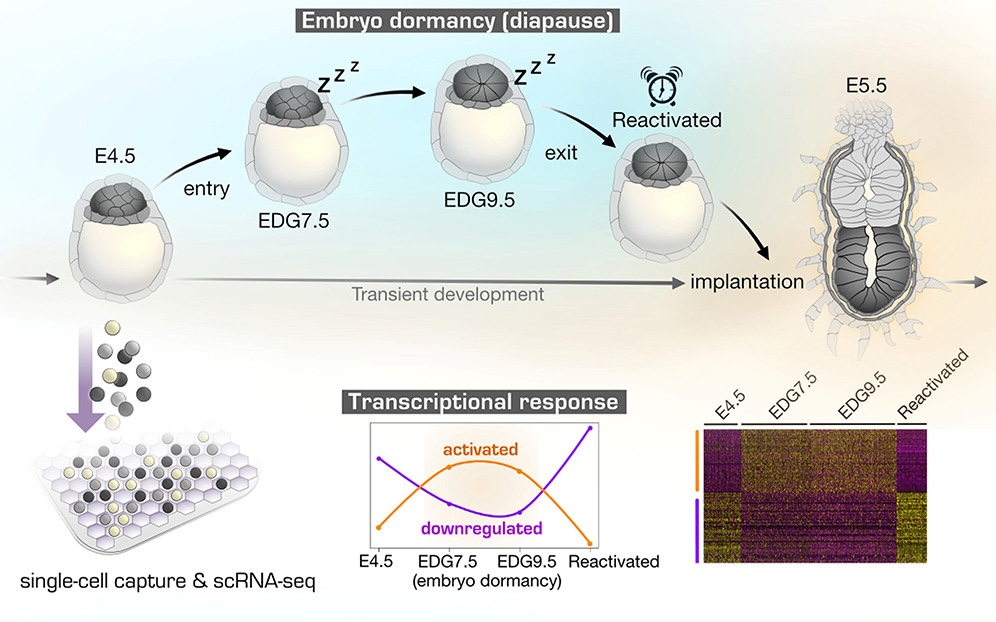
To investigate this process, we used single-cell RNA sequencing to follow mouse embryos as they entered, progressed through and exited diapause.
This allowed us to build a single-cell atlas covering the transition from normal development into dormancy and back to active development.
We found that diapause is not simply a state in which everything is switched off. Instead, the embryo undergoes extensive and dynamic changes in gene expression.
Different cell populations respond in distinct ways as development slows down. The pluripotent epiblast, in particular, undergoes a series of transcriptional changes that allow it to adapt to prolonged developmental arrest while maintaining its potential to resume development.
A dormant embryo is still an active embryo
One of the most interesting insights from our work was that embryonic diapause is not a simple pause button.
As embryos enter dormancy, their transcriptional programmes change substantially. During prolonged diapause, these changes continue, indicating that the embryo remains responsive to its environment even though its overall development has stopped.
When the embryos are reactivated, their transcriptional state changes again as they prepare to resume development.
This reveals diapause as a dynamic and regulated state, rather than a passive suspension of embryonic activity.
How does a dormant embryo stay alive?
The most striking finding emerged when we looked at the mechanisms that allow pluripotent cells to survive during prolonged dormancy.
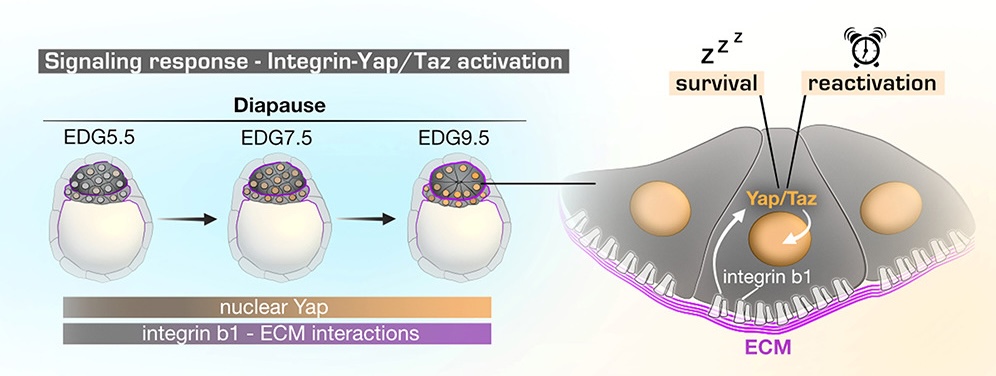
We found that dormant epiblast cells activate integrin signalling. Integrins are receptors that allow cells to sense and interact with their extracellular environment, including the extracellular matrix surrounding them.
This environmental information is transmitted through the YAP/TAZ pathway, a major regulator of cell survival, growth and tissue adaptation.
During diapause, integrin–YAP/TAZ signalling becomes activated and helps maintain the viability of the dormant epiblast.
When we interfered with this pathway, dormant embryos became less capable of surviving and reactivating. This demonstrated that integrin–YAP/TAZ signalling is not simply associated with dormancy—it is an important component of the mechanism that allows embryos to endure it.
A connection between the embryo and its environment
These findings suggest that the ability of an embryo to survive dormancy depends on more than its internal developmental programme.
The embryo continuously interacts with its surrounding environment, and integrins provide a way for dormant cells to sense that environment and activate intracellular survival mechanisms.
In this way, the extracellular matrix and the cell’s signalling machinery become part of the embryo’s strategy for surviving developmental arrest.
Why does this matter?
Embryonic diapause provides a unique opportunity to understand how living cells can temporarily stop developmental progression without losing their identity or viability.
Our work shows that this state involves extensive transcriptional remodelling and that dormant embryonic cells actively engage a survival programme centred on integrin–YAP/TAZ signalling.
More broadly, this work highlights a fundamental principle of developmental biology: development does not always have to move forward continuously. Embryos can adapt to changing conditions, enter a protective dormant state and later resume their developmental programme.
By defining the molecular landscape of embryonic diapause at single-cell resolution and identifying integrin–YAP/TAZ signalling as a key survival mechanism, we provide a framework for understanding how embryos balance development, dormancy and survival.
Read the research article:
Analyzing embryo dormancy at single-cell resolution reveals dynamic transcriptional responses and activation of integrin-Yap/Taz prosurvival signaling
Chen R, Fan R, Chen F, Govindasamy N, Brinkmann H, Stehling M, Adams RH, Jeong HW, Bedzhov I.
Cell Stem Cell 2024
https://doi.org/10.1016/j.stem.2024.06.015

You must be logged in to post a comment.