
During early embryonic development, cells need to coordinate two fundamental processes: deciding what they will become and organising themselves into tissues. These processes have to happen in the right order and at the right time. But how does an embryo coordinate changes in cell identity with the physical organisation of its cells?
Two of the most famous regulators of embryonic cell identity are Oct4 and Sox2. They are best known for maintaining pluripotency—the ability of embryonic cells to give rise to all the cell types of the body. We wondered whether these factors might have functions beyond simply maintaining developmental potential.
A surprising role for pluripotency factors
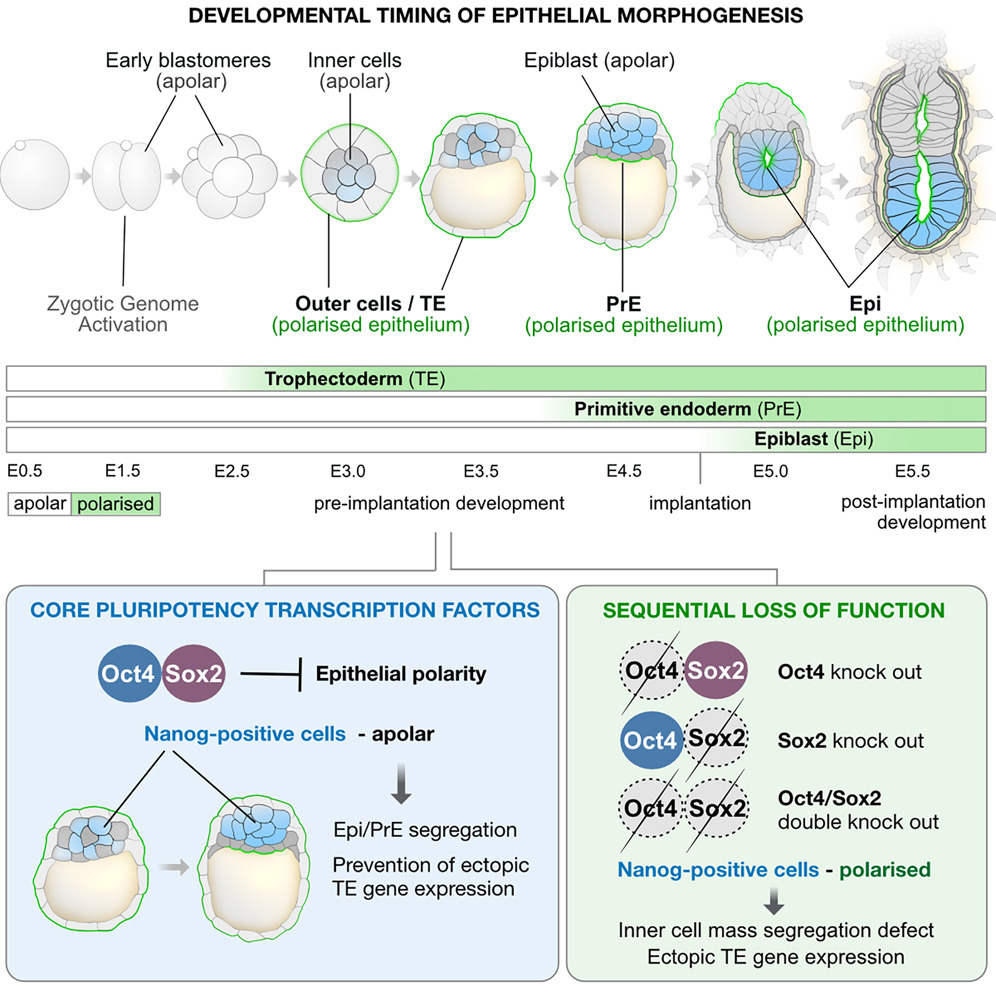
As the early mouse embryo develops, cells of the inner cell mass give rise to the epiblast and primitive endoderm. At the same time, the epiblast undergoes a major transformation: its cells become polarised and organise into an epithelial layer.
This epithelialisation is a crucial step in embryonic morphogenesis. It provides the organisation and architecture required for the embryo to continue developing.
We found that Oct4 and Sox2 actively control the timing of this process.
Rather than simply promoting pluripotency, Oct4 and Sox2 act as a developmental brake. Their expression after the 8-cell stage prevents epiblast cells from activating the epithelial programme too early.
Why does timing matter?
At first glance, delaying epithelialisation might seem counterintuitive. Why would the embryo prevent its cells from organising themselves?
The answer is that developmental events need to occur in the correct sequence.
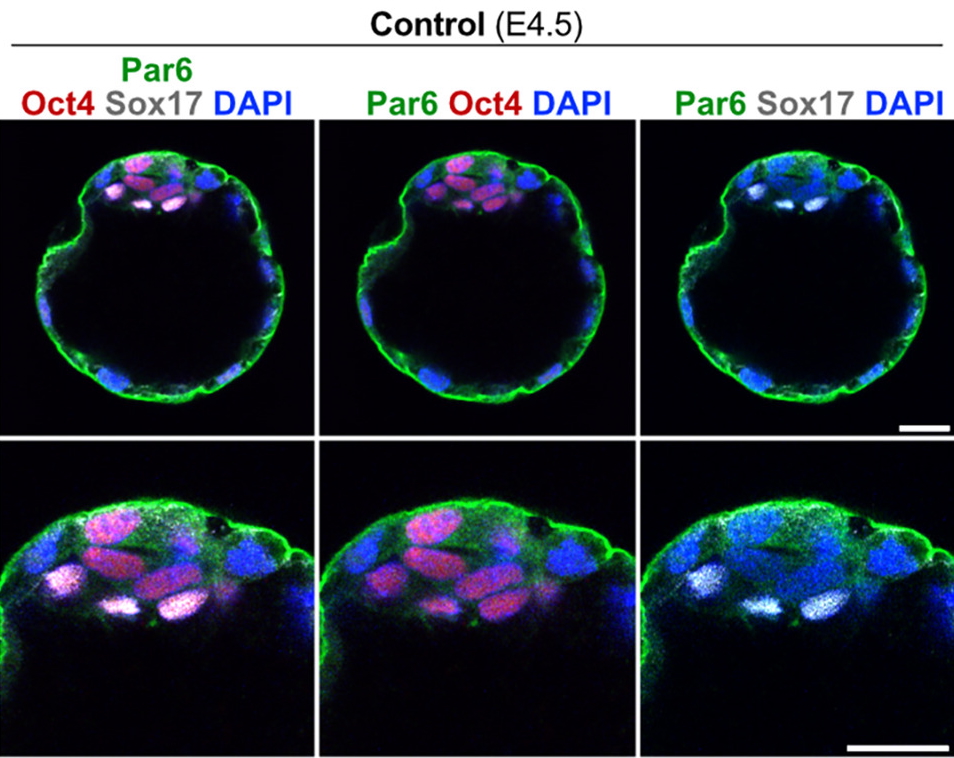
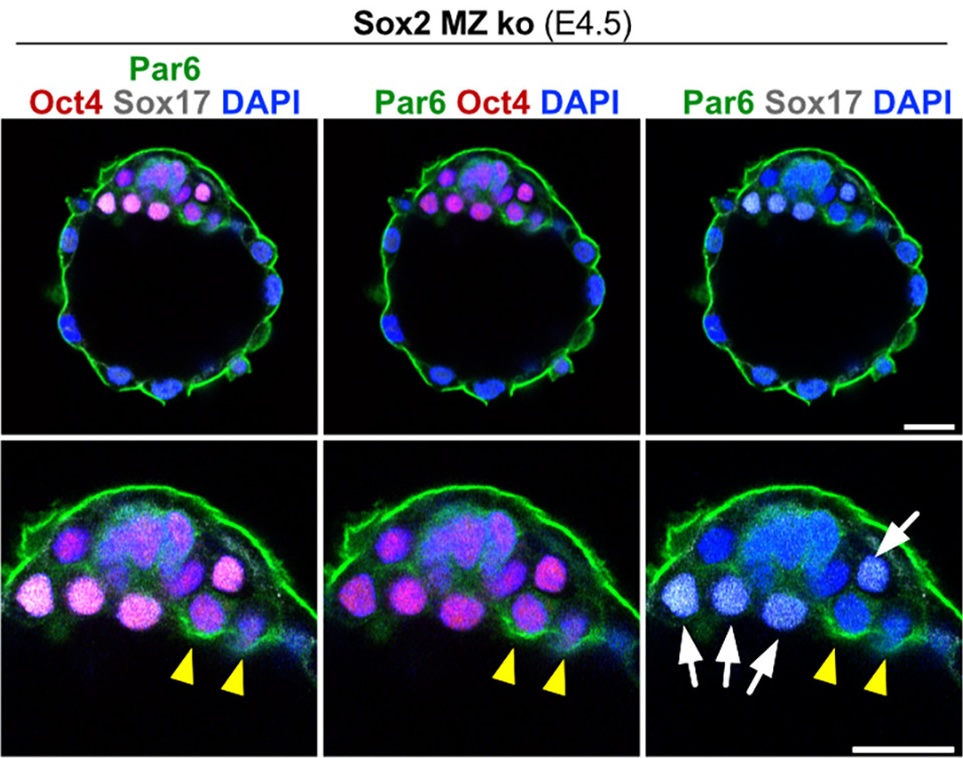
Before the epiblast fully epithelialises, the embryo needs to complete a second important lineage segregation, separating epiblast and primitive endoderm. We found that Oct4 and Sox2 help keep the epiblast in a relatively apolar state, giving the embryo time to complete this lineage decision.
When we removed Oct4 or Sox2 at specific developmental stages, the consequences depended strongly on when the factors were lost. This sequential loss-of-function approach allowed us to distinguish their early and later functions and revealed that the timing of their expression is critical for normal development.
In the absence of this regulatory brake, the epithelial programme can become activated prematurely, disrupting the normal progression of lineage segregation.
Oct4 and Sox2 coordinate cell fate and tissue organisation
Our findings reveal an unexpected second dimension to the function of pluripotency factors.
Oct4 and Sox2 are traditionally viewed as regulators of cell identity. They maintain the developmental potential of embryonic cells and control the pluripotency network.
We found that they also regulate tissue morphogenesis by controlling when cells acquire epithelial polarity and begin to organise into a tissue.
In this way, Oct4 and Sox2 connect two processes that are often considered separately:
Developmental capacity
Oct4 + Sox2 → maintenance of pluripotency
Tissue organisation
Oct4 + Sox2 → suppression of premature epithelialisation → appropriately timed morphogenesis
This dual function allows the embryo to coordinate what its cells can become with when they are ready to organise themselves.
Development is not simply a sequence of cell-fate decisions
Our work highlights a broader principle in embryonic development: cell fate specification and tissue morphogenesis are tightly interconnected.
An embryo cannot simply tell cells what they should become. It also needs to control when those cells change their shape, polarity and organisation. By keeping the epiblast apolar for a defined period, Oct4 and Sox2 provide a temporal window in which lineage segregation can be completed before tissue morphogenesis begins.
This gives these classic pluripotency factors a role that extends beyond maintaining stem-cell identity.
We found that Oct4 and Sox2 do not only determine what embryonic cells can become—they also help determine when those cells are ready to organise into a tissue.
By coordinating developmental capacity with the timing of morphogenesis, Oct4 and Sox2 help keep early embryonic development on schedule.
Read the research article:
Dual role of Oct4 and Sox2 in controlling the developmental capacity and timing of tissue morphogenesis in the embryonic lineage
Chandramohan D, Yan R, Kruse K, Brinkmann H, Jeong H-W, Hou Y, Adachi K, Schöler HR, Bedzhov I
Developmental Cell 2026
https://doi.org/10.1016/j.devcel.2025.11.003

You must be logged in to post a comment.