
Early embryonic development requires a remarkable change in cellular activity. Before implantation, the mouse embryo is relatively metabolically quiet. After implantation, this changes dramatically: the epiblast begins to proliferate rapidly, reorganises into an epithelial structure and undergoes the morphogenetic transformations that build the foundation of the future embryo.
What controls this transition from a metabolically quiet state to one capable of supporting rapid growth and tissue organisation? In this study, we identified the transcription factor Ronin (also known as THAP11; Ronin (浪人, samurai without a master)) as an important regulator of this transition. We found that Ronin enables the embryonic lineage to increase its metabolic capacity, allowing cells to meet the energetic demands of post-implantation growth and morphogenesis.
From a quiet embryo to an active embryo
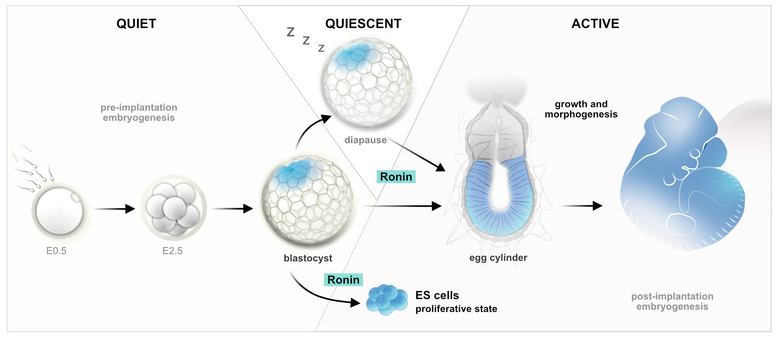
The blastocyst contains a small population of naïve pluripotent cells that will give rise to the embryo proper. At this stage, these cells are relatively metabolically quiet. Following implantation, however, everything accelerates. The epiblast starts proliferating, cells change their organisation and the simple cluster of pluripotent cells transforms into the highly organised egg-cylinder structure.
We were interested in understanding why Ronin, a transcription factor previously associated with cell proliferation and metabolism, becomes essential precisely at this developmental transition.
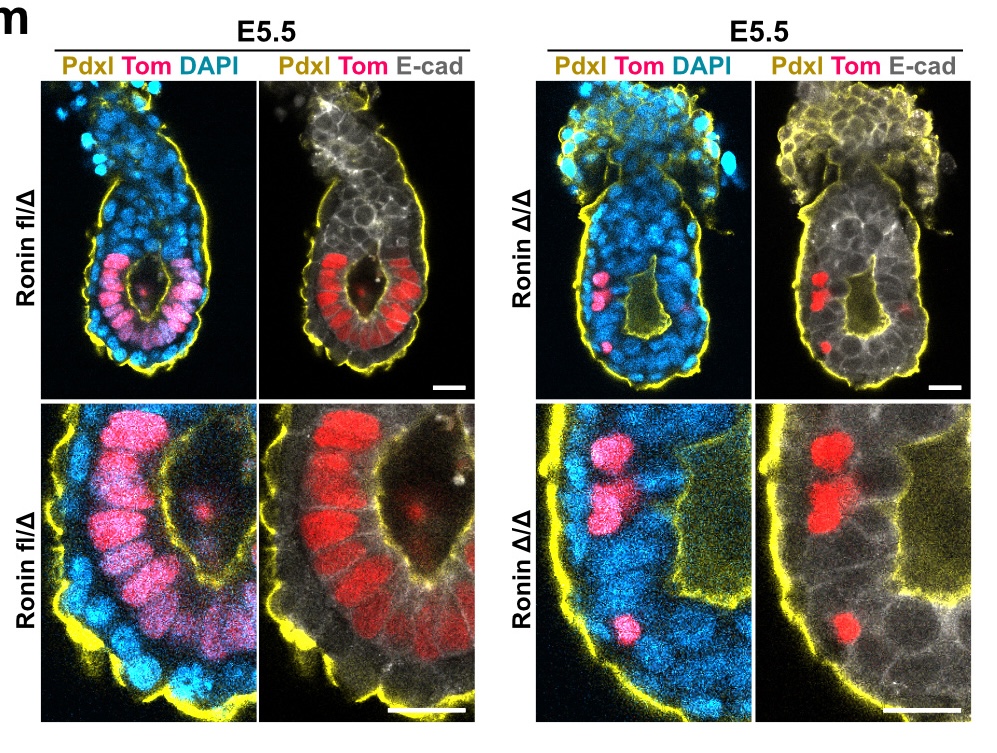
This was particularly intriguing because embryos lacking Ronin can develop normally through the preimplantation stages and form apparently normal blastocysts. The problem emerges later: Ronin-deficient embryos fail to properly develop the post-implantation epiblast and cannot form the characteristic egg-cylinder structure.
Without Ronin, cells enter a state of quiescence
To understand what was happening at the cellular level, we first removed Ronin from embryonic stem cells.
The result was striking. Rather than immediately dying or losing their identity, the cells gradually entered a reversible quiescent state. Their proliferation slowed, while naïve pluripotency was actually enhanced. Pluripotency-associated factors such as Tfcp2l1, Nanog and Prdm14 increased, whereas genes associated with exiting naïve pluripotency were reduced.
This suggested that Ronin does not simply act as a conventional proliferation factor. Instead, its absence appears to keep cells in a developmental state resembling the metabolically quiet condition of the early embryo.
This raised an important question: what happens to the metabolism of these cells?
Ronin keeps the mitochondria ready for action
We found that loss of Ronin profoundly affected mitochondria. Ronin-deficient cells developed abnormal mitochondrial morphology, including changes in the organisation of the mitochondrial cristae—the internal membrane structures that house the machinery responsible for energy production.
These structural changes were accompanied by a major reduction in mitochondrial respiration. Measurements of oxygen consumption showed reductions in basal and maximal respiration as well as ATP-linked respiration. In other words, without Ronin, the cells were much less capable of producing energy through oxidative phosphorylation.
This provided a potential explanation for the developmental phenotype.
The post-implantation epiblast is not simply a larger version of the blastocyst. It is a rapidly growing and dynamically reorganising tissue. Cell division, protein synthesis, membrane trafficking and morphogenesis all require substantial amounts of energy.
Ronin therefore appears to help the embryonic cells prepare their metabolic machinery for the energetic demands of the next developmental stage.
Connecting metabolism with tissue organisation
Interestingly, the consequences of losing Ronin were not limited to metabolism.
Ronin also regulates the expression of genes encoding ribosomal proteins and other components involved in biosynthetic activity. In Ronin-deficient embryos, the pluripotent lineage failed to properly organise into the polarised epithelial structure characteristic of the post-implantation epiblast.
This suggests that metabolism and morphogenesis are closely connected.
An embryo cannot simply activate a developmental programme at the level of gene expression. Cells must also have sufficient energy and biosynthetic capacity to execute that programme. Building an epithelial tissue, changing cell shape, establishing polarity and proliferating rapidly all require substantial cellular resources.
Ronin appears to be part of the mechanism that makes those resources available.
A metabolic gate for developmental progression
Our findings led us to a broader model of early embryonic development.
The preimplantation embryo and the dormant embryo during diapause exist in relatively low-activity states. Following implantation—or reactivation from diapause—the embryonic lineage must switch into a highly active metabolic and proliferative state.
We found that Ronin is a key component of this transition. It supports mitochondrial function and energy production, fine-tunes the machinery required for protein synthesis and ultimately enables the pluripotent lineage to sustain rapid proliferation and morphogenesis.
This also helps explain why Ronin is dispensable during early embryogenesis but becomes essential after implantation. The requirement for Ronin is not simply determined by the identity of the cells. It emerges when the energy demands of development increase.
In this sense, Ronin acts as a kind of metabolic gatekeeper: it helps determine whether pluripotent cells have the capacity to leave a quiet state and enter the energetically demanding phase of post-implantation development.
In short
We found that Ronin/THAP11 links cellular metabolism with developmental progression. By supporting mitochondrial structure and function, energy production and biosynthetic capacity, Ronin enables pluripotent cells to transition from a metabolically quiet state into the highly active state required for proliferation and tissue morphogenesis.
Our work highlights an important principle of embryonic development: cell fate and tissue organisation cannot be separated from the metabolic state of the cells that build the embryo. Before cells can grow and organise a tissue, they need to be able to power the process.
Read the research article:
Ronin governs the metabolic capacity of the embryonic lineage for post-implantation development
Salewskij K, Gross-Thebing T, Ing-Simmons E, Duethorn B, Rieger B, Fan R, Chen R, Govindasamy N, Brinkmann H, Kremer L, Kuempel-Rink N, Mildner K, Zeuschner D, Stehling M, Dejosez M, Zwaka TP, Schöler HR, Busch KB, Vaquerizas JM, Bedzhov I.
EMBO Reports 2022
https://doi.org/10.15252/embr.202153048

You must be logged in to post a comment.