
The early mouse embryo begins as a remarkably simple structure: a small group of pluripotent epiblast cells. Yet within a short period of time, these cells undergo a dramatic transformation. They change their developmental state, become polarised and reorganise into an epithelial tissue that will provide the foundation for building the body plan.
We wanted to understand how these two processes—changes in cell identity and changes in tissue organisation—are coordinated.
From a ball of cells to an organised tissue
Before implantation, epiblast cells are relatively unorganised and lack the characteristic polarity of an epithelium. After implantation, this changes dramatically.
The cells establish an apical-basal polarity, become tightly connected to one another and form an epithelial sheet. At the same time, the pluripotency state of the epiblast is changing.
This raised an important question: how does an embryonic cell know when it is time to stop being a relatively unstructured pluripotent cell and start becoming part of an organised tissue?
A small molecular switch with a big role
We identified Rap1, a small GTPase, as a key regulator linking these two processes.
Rap1 is best known for controlling cell adhesion and interactions between cells. We found that it has a much broader role during early embryonic development.
Rap1 activity is regulated by the pluripotency factors Oct4 and Esrrb, placing it downstream of the transcriptional network that controls the developmental state of the epiblast.
In this way, changes in pluripotency can be translated into changes in cell organisation.
Building epithelial polarity
When Rap1 is activated, it helps transmit the signals that establish polarity within epiblast cells. This promotes the formation of the complexes that connect cells to their extracellular environment and to one another.
In particular, Rap1 is required for the formation of talin–integrin complexes and specialised cell-cell junctions.
One particularly interesting feature of this process is the formation of tricellular junctions—structures where three epithelial cells meet. These junctions are a hallmark of the mature epithelial organisation that emerges during epiblast morphogenesis.
Without functional Rap1, this process is disrupted. Cells fail to properly transmit the polarity cues required to organise the epiblast into a coherent epithelial sheet.
Synchronising cell state and tissue shape
Our findings reveal that the transition in pluripotency and the transition in tissue architecture are not independent events.
Rather than cells first changing their identity and only later changing their organisation, these processes are tightly coupled. As the pluripotency state changes, Rap1 helps translate this developmental information into a physical transformation of the tissue.
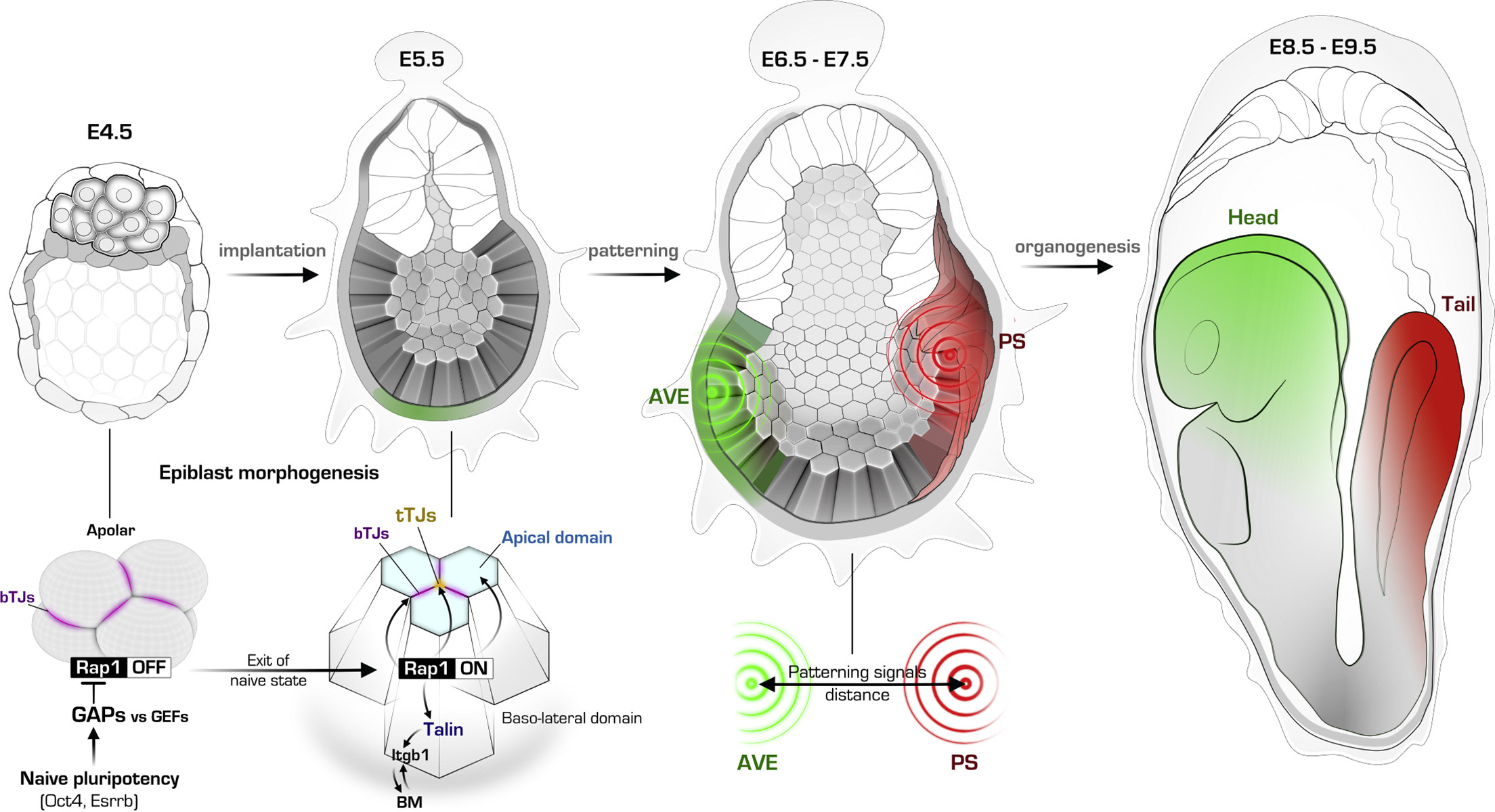
Rap1 orchestrates the morphogenetic program in the embryonic lineage in sync with the pluripotency states transitions.
Building the foundation for the body plan
The importance of this process goes beyond simply making the epiblast look more organised.
Once the epiblast becomes an epithelial sheet, it provides the physical framework on which the next stages of embryonic patterning can take place. Signals can then act on an organised tissue to establish the axes and structures of the developing embryo.
The epiblast therefore needs to become organised at the right time.
Too early, and morphogenesis could occur before the appropriate developmental decisions have been completed. Too late, and the embryo would lack the organised tissue architecture needed for subsequent patterning.
Rap1 provides a mechanism for synchronising these two processes.
From cell state to tissue architecture
Our work highlights a broader principle of embryonic development: cell fate and tissue organisation are deeply interconnected.
The molecular networks that define the developmental state of a cell can also control how that cell interacts with its neighbours and its environment. In this case, the pluripotency factors Oct4 and Esrrb regulate Rap1, which in turn translates changes in cell state into changes in polarity, adhesion and tissue architecture.
We found that Rap1 acts as a molecular switch that coordinates the transition of the epiblast from a pluripotent cell population into an organised epithelial tissue.
This provides a mechanism by which the embryo can synchronise developmental progression with morphogenesis, ensuring that cells not only know what they are becoming, but also when it is time to organise themselves into a tissue.
Read the research article:
Rap1 controls epiblast morphogenesis in sync with the pluripotency states transition
Kim YS, Fan R, Lith SC, Dicke AK, Drexler HCA, Kremer L, Kuempel-Rink N, Hekking L, Stehling M, Bedzhov I.
Developmental Cell 2022
https://doi.org/10.1016/j.devcel.2022.07.011

You must be logged in to post a comment.