
Early embryonic development is often described as a process in which cells progressively make increasingly irreversible decisions about their identity. But in the very early embryo, cells are remarkably flexible. They can adapt to changes in their environment, compensate for differences in cell number or position, and still contribute to a properly organised embryo.
We wanted to understand how long this developmental plasticity persists and whether it could be harnessed to generate new types of embryonic structures.
When two cell fates can coexist
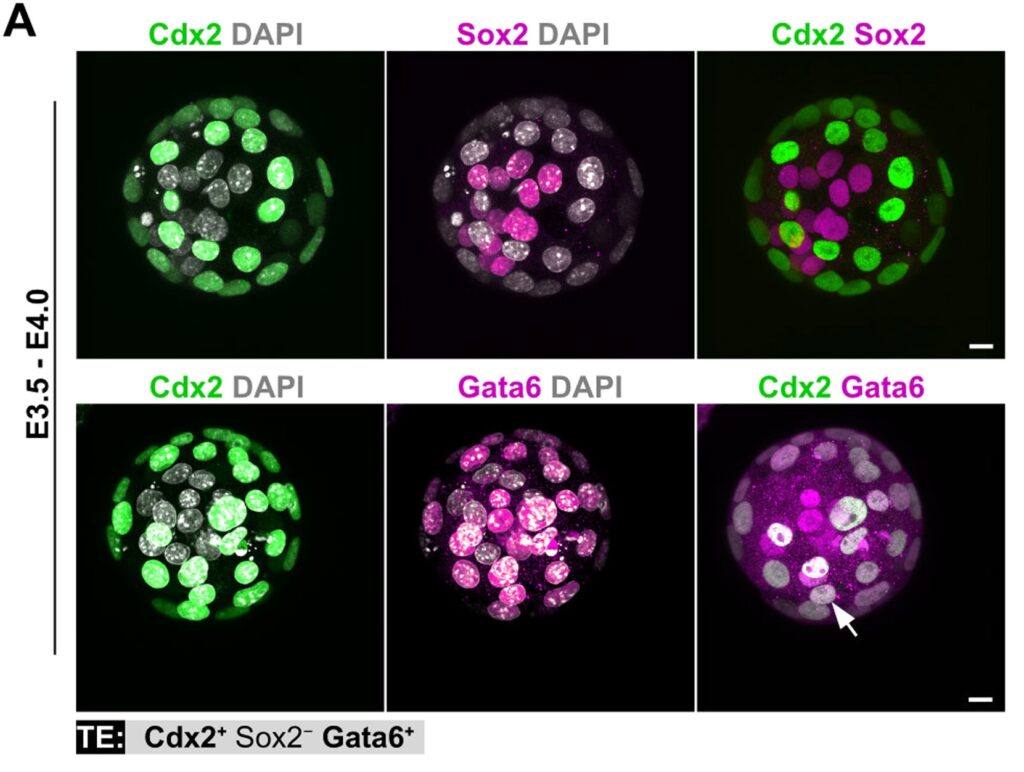
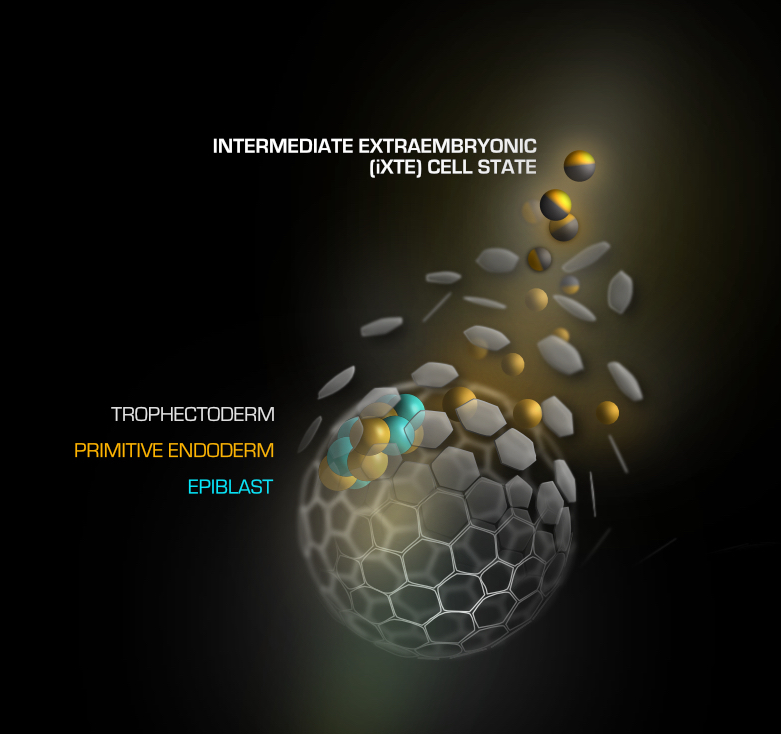
During the first lineage segregation in the mouse embryo, cells separate into two extraembryonic lineages: the trophectoderm, which contributes to the placenta, and the primitive endoderm, which forms part of the tissues surrounding the embryo.
These lineages are normally considered distinct once this segregation has occurred.
We found that this separation is not as irreversible as it might appear.
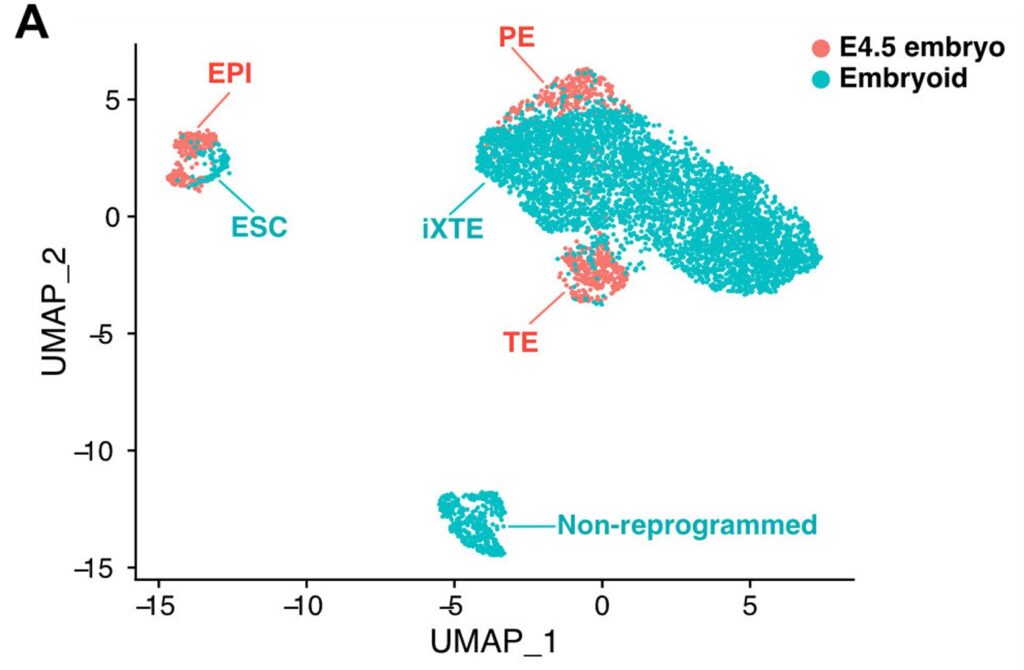
By developing specific culture conditions, we were able to maintain cells with characteristics of both primitive endoderm and trophectoderm in the same population. These cells occupy an intermediate and highly plastic state, retaining the ability to contribute to either extraembryonic lineage.
This revealed that the early embryo has a broader window of developmental flexibility than previously appreciated.
Extending the embryo’s developmental potential
We next asked whether this plasticity was simply a feature of individual cells or whether it could influence how cells organise themselves into tissues.
The answer was striking.
Cells in this intermediate state could contribute to both extraembryonic lineages and participate in the formation of organised, higher-order structures resembling blastocysts.
In other words, the plasticity of individual cells could be translated into self-organisation at the tissue level.
Plasticity and self-organisation
Embryonic development relies on two remarkable properties.
The first is developmental plasticity—the ability of cells to adapt their fate when circumstances change.
The second is self-organisation—the ability of cells to spontaneously arrange themselves into a structured tissue without every aspect of that organisation being explicitly instructed.
Our experiments revealed an unexpected connection between these two properties.
The intermediate extraembryonic state provides cells with enough flexibility to adopt different fates, while also allowing them to interact with one another and organise into increasingly complex structures.
This suggests that developmental plasticity is not simply a mechanism for correcting errors. It can also provide the raw material for building new tissue architectures.
What does this tell us about early development?
Our findings challenge the idea that lineage segregation is simply a one-way process in which cells progressively lose developmental potential.
Instead, early embryonic cells can retain a surprising degree of flexibility even after the first lineage decision has begun.
This flexibility may be particularly important during the earliest stages of development, when the embryo has very few cells and must be able to compensate for changes in cell number, position or behaviour.
More broadly, our work highlights the close relationship between cell fate and tissue organisation. The ability of cells to change their identity and the ability of cells to organise themselves are not separate properties—they can reinforce one another.
We found that early extraembryonic cells can enter an intermediate state with remarkable developmental plasticity, allowing primitive endoderm- and trophectoderm-like identities to coexist and enabling the assembly of organised blastocyst-like structures.
These findings provide a new perspective on how early embryos remain flexible while simultaneously building increasingly complex structures.
Read the research article:
Early developmental plasticity enables the induction of an intermediate extraembryonic cell state
Sathyanarayanan A, Ing-Simmons E, Chen R, Jeong HW, Ozguldez HO, Fan R, Duethorn B, Kim KP, Kim YS, Stehling M, Brinkmann H, Schöler HR, Adams RH, Vaquerizas JM, Bedzhov I.
Science Advances 2022
https://doi.org/10.1126/sciadv.abl9583

You must be logged in to post a comment.